Sofa Foam Replacement Faridabad — End Sagging Cushions for Good
Specialist foam replacement for Faridabad's discerning homeowners. High-density, memory foam and custom-profile cushion restoration for sofas, sectionals and statement seating across every premium address in the city.
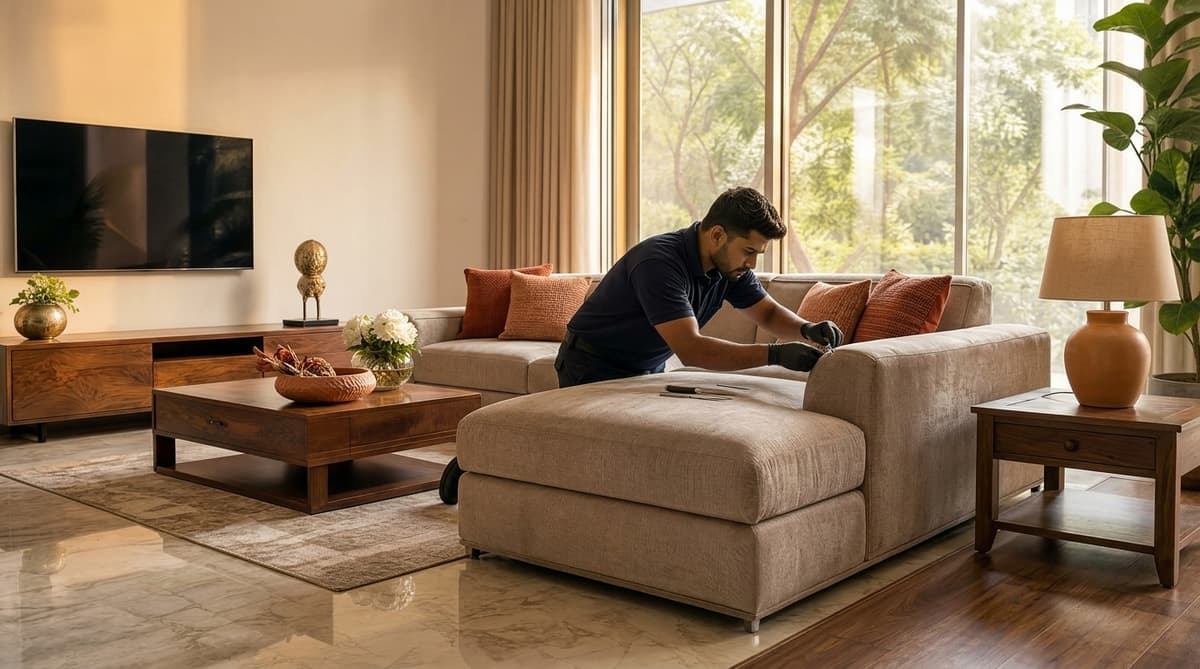
Sofa Foam Replacement in Faridabad | Premium upholstery & foam service | Home visit | FurniRevive
Quick Answer
FurniRevive replaces sofa foam in Faridabad using high-density, high-resilience and memory foam grades matched to your seating preference. We collect and return your sofa, and the result is cushions that feel genuinely new — not a temporary improvement.
Trusted by thousands of families across Faridabad, FurniRevive is the go-to choice for dependable, quality furniture repair with a warranty you can count on.
Foam is the one component in an expensive sofa that is engineered to wear out. A quality hardwood frame lasts indefinitely. Premium upholstery fabric has a useful life of ten to fifteen years with reasonable care. But foam — even high-quality foam in a well-made piece — will compress, lose its resilience and eventually lose its structural integrity over time. This is not a manufacturing defect; it is the physics of polymer degradation under repeated load. The relevant question is what you do about it.
In Faridabad's premium residential market — the villas in Sector 46, the large apartments in Omaxe Heights, the townhouses in Puri Aman Vilas — sofas are often genuinely valuable pieces. Replacing them when the foam wears out makes no more sense than replacing a luxury car because the tyres are worn. The structure, the frame, the upholstery — all of this can continue to serve for many more years if the foam is replaced correctly. The challenge is that foam replacement done incorrectly, with the wrong density or grade, delivers a result that disappoints within 18 months.
The foam market in India is complex in ways that most consumers are not aware of. Density ratings (the kg/m³ figure) and resilience ratings (the percentage compression load deflection) are the two metrics that actually determine how a cushion feels and how long it lasts. A foam rated at 40 kg/m³ density with high resilience will hold its form for five to seven years under normal residential use. A 20 kg/m³ foam — standard in most budget sofas and in many mid-market pieces — may begin to show compression within 18 months.
We specify foam grades the way a mattress manufacturer would — by matching density, resilience and firmness to the application and the user's preferences. Our clients in Sector 85 and SRS Residency get to choose from a range of profiles: firm support, medium comfort, soft luxury, or a layered combination. This is not a detail that most foam replacement services bother with, but it is the detail that separates a foam job that still feels good in year four from one that has already disappointed.
With rising furniture prices across Delhi NCR, residents in Faridabad increasingly turn to professional repair as the smart, economical alternative to buying new.
Sofa Repair Near Me in Faridabad
A FurniRevive technician reaches Faridabad within 2–4 hours.
Searching for reliable sofa repair near me in Faridabad? FurniRevive provides doorstep sofa repair at your residential locality with a 2–4 hours technician response across Faridabad. We bring everything needed — high-density foam, matching fabric, recliner parts, webbing springs — to complete home sofa repair right in your living room. From torn fabric and sagging cushions to cracked leather and broken frames, we repair all sofa types: fabric, leather, wooden, recliner, and sofa cum bed.
Whether your sofa has a sagging seat from flat foam, needs sofa spring repair, sofa frame repair, recliner mechanism work, or torn sofa repair for fabric or leather, our same-day sofa repair service in Faridabad handles it all. Sofa repair price in Faridabad starts at ₹500 per seat with a free doorstep inspection included. Book a sofa technician near you today — all repairs come with a 6-month warranty.
Sofa Repair Service in Faridabad and Nearby Areas
Fastest response near Crown Interiorz Mall, YMCA Chowk, Surajkund Crafts Mela Ground. Our locally stationed technicians complete sofa repair in Faridabad every day — at apartments, independent houses, offices, and restaurants alike. Transparent pricing starting ₹500 with a free doorstep inspection before any work begins.
Frequently Asked Questions — Faridabad
- How much does sofa repair cost in Faridabad?
- Sofa repair cost in Faridabad starts at ₹500 for basic cushion work. Foam replacement is ₹999–₹2,500 per seat, fabric re-upholstery from ₹2,000 per seat, leather sofa repair from ₹1,500, and full set restoration from ₹8,000. FurniRevive provides a free doorstep inspection before any work begins — no obligation, no hidden charges.
- Is the doorstep inspection free in Faridabad?
- Yes, FurniRevive offers a completely free doorstep inspection in Faridabad. Our technician visits your home, diagnoses the sofa thoroughly, and provides a detailed itemised quote — no obligation, no call-out fee. Repair work only begins after you approve the quote.
- Is there a warranty on sofa repair in Faridabad?
- All repairs completed in Faridabad are backed by a 6-month written warranty. It applies to every job — from a single cushion foam replacement to a full 5-seater restoration. Contact us within the warranty period for any covered issue and our technician returns for free.
- Do you offer same-day sofa repair in Faridabad?
- Same-day doorstep sofa repair in Faridabad is available when you book early in the day. WhatsApp us photos of the damage at +91 92179 99355 and we'll confirm a same-day slot. For urgent jobs, calling directly is faster than the online form.
- How long does a sofa technician take to reach Faridabad?
- Our nearest sofa technician reaches your address in Faridabad within 2–4 hours in most cases. For early-morning bookings, the technician often arrives within 1–2 hours. WhatsApp +91 92179 99355 with your pincode or society name for the most accurate estimate.
- Which areas near Faridabad do you service?
- FurniRevive covers Faridabad and the surrounding Faridabad areas under a single, consistent pricing structure. Our technicians don't charge extra for travelling between sectors or neighbouring colonies. Confirm your specific address by calling 92179 99355 or WhatsApp-ing +91 92179 99355.
- How do I know if my sofa is worth repairing or should be replaced in Faridabad?
- For sofa owners in Faridabad, the repair-vs-replace decision comes down to frame quality and budget. A solid frame can be fully restored — new foam, springs, and fabric — for ₹12,000–₹22,000, saving 60–70% over a new sofa. FurniRevive's free inspection gives you an honest assessment with no sales pressure to repair.
Why Choose FurniRevive?
Correctly Specified Foam — Not Just Any Foam
We grade foam properly — density, resilience, ILD firmness — and match the specification to the application. Living room sofa foam is different from a day bed, a sectional seat is different from a back cushion. Correct specification is what prevents premature compression.
Full Range: High-Density, HR, Memory Foam
Our foam inventory covers the full quality spectrum from standard high-density through high-resilience (HR) grades to memory foam and natural latex. We stock what is not available at local foam wholesale markets, including the HR grades used in commercial-quality furniture.
Home Collection & Delivery
We collect your sofa from your home in Faridabad, complete the foam replacement in our workshop and return the finished piece. You do not need to dismantle, transport or source replacement foam yourself.
Sectional Expertise
Sectional sofas require foam that is matched across all modules — firmness, height, and profile — to ensure consistent seating across the entire configuration. We measure and cut foam for all modules simultaneously rather than treating each section as a separate job.
Integrated with Upholstery
If your cushions need both new foam and new fabric, we handle both in one service visit. This is more cost-efficient than two separate jobs and ensures the fabric is fitted to the new foam profile correctly rather than applied to the old dimensions.
Pre-Work Assessment — No Hidden Surprises
Before foam is cut, we assess the condition of the sofa's structural base and existing upholstery. If we find additional issues, we report them before proceeding. You are never charged for work not discussed in advance.
Our Repair Process
Home Visit & Cushion Assessment
A technician visits your home in Faridabad to assess the current foam's condition, measure all cushion dimensions and discuss your firmness and comfort preferences. We test current compression levels to confirm which sections require full replacement versus topping.
Foam Specification & Selection
Based on the assessment, we recommend appropriate foam grades for each cushion type — seat, back, armrest. You choose from our firmness profiles: firm, medium or soft. For clients with specific back support requirements, we can recommend layered foam constructions.
Collection
We collect the sofa from your home on an agreed date, carefully protecting the upholstery during transit. In our workshop, the cushion covers are removed, old foam extracted and dimensions finalised for cutting.
Precision Cutting & Fitting
Foam is cut to precise dimensions on calibrated equipment — not by hand with a kitchen knife, which produces uneven surfaces and air pockets. Edges are shaped, corners are mitred and seat domes are profiled where required to create the correct seating geometry.
Reassembly & Quality Check
Foam is inserted into covers, cushions are checked for symmetry and firmness consistency, and the reassembled sofa is inspected in full before it is wrapped for transport back to your home.
Delivery & Placement
We return the sofa to your home in Faridabad, position it correctly and take you through the expected break-in period — most high-density foam softens by approximately 10% in the first two to four weeks of normal use before stabilising at its long-term profile.
Why Faridabad Homeowners Choose Foam Replacement
The connection between good furniture and daily quality of life is more direct than it might seem. A sofa used for two to four hours daily in a Sector 21C living room or a Greater Faridabad villa is an ergonomic environment as much as it is a decorative piece. When that sofa's foam has compressed to the point where you feel the frame beneath you, or the cushion no longer springs back after you stand up, it is not just cosmetically unsatisfying — it is physically poor support for the people using it.
Faridabad residents who have invested in quality furniture understand this instinctively. The question that brings them to us is usually: 'Is it worth restoring, or should I just replace it?' In the overwhelming majority of cases involving sofas from the mid-to-premium market, restoration is the correct answer. The frame quality and upholstery integrity of a ₹1.5–3 lakh sofa will outlast two or three foam replacements. The economics are compelling.
There is also a practical advantage to foam replacement over sofa replacement for residents of large apartment complexes like Omaxe Heights or Emerald Heights: getting a large new sofa into an upper-floor apartment is a considerable logistical challenge. Removing and returning a piece you already own, via a service that handles all the logistics, is simply easier.
We have been servicing Faridabad's premium residential market long enough to know that the same clients come back to us for foam replacement on different pieces over time. The word-of-mouth within residential communities like RPS Savana and BPTP Parklands is that we do this work at a quality level that is not available through standard local channels.
Common Cushion Problems in Faridabad Homes
The most common presentation is uneven wear — the seat cushions on one side of a sofa are noticeably more compressed than the other side because one position is used far more frequently. This is normal and expected, but it creates a visual and physical imbalance that becomes increasingly difficult to ignore. Rotating cushions helps slow the process but does not reverse it once compression has occurred.
Bottom-out compression — where the cushion compresses fully under load, leaving the sitter essentially on the frame — is a more advanced problem. At this stage, the foam has lost its resilience entirely rather than just reducing in height. The tactile difference between a compressed cushion and a failed one is significant: compressed foam still offers some resistance; failed foam offers almost none. We see this in sofas that were purchased with marginal foam density to begin with and used heavily for several years.
Back cushion flattening is a separate issue from seat cushion failure. Back cushions typically use lower-density foam than seats because they are subjected to less direct compressive load. However, in sofas that are used for extended periods — working from home setups, which are common in Faridabad's professional households — the back cushion receives more load than it was designed for and compresses faster than expected.
Delamination — where multiple layers of foam in a cushion begin to separate — produces a distinctive 'lumpy' feel rather than a flat compressed feel. This is caused either by age-related adhesive failure or by moisture penetration between layers. It is more common in households in lower-floor apartments where humidity levels are higher. Delaminated foam cannot be repaired; it must be replaced.
Signs Your Sofa Cushions Need Replacement
The most reliable physical test is the depression test: press firmly on the seat cushion and release. Quality foam in good condition springs back to its original height within two to three seconds. Foam with reduced resilience takes five to ten seconds to return. Fully compressed foam does not return at all — it simply stays depressed until you manually fluff it. If your cushions fail the depression test consistently across multiple seats, foam replacement is overdue.
Another indicator is visible sagging when the sofa is unoccupied. Quality foam holds its shape under its own weight. Foam that has compressed to the point where it cannot maintain cushion shape at rest — creating a visible dip or flatten in the seat — has reached end of useful life. At this stage, the foam is also providing inadequate support when occupied.
An increase in noise from the sofa — creaking, clicking or frame sounds that were not present when the piece was newer — is often a secondary sign of foam failure. As foam compresses, it no longer provides the buffer layer between the occupant's weight and the sofa frame. This transfers more direct impact to the frame connections and spring system, increasing stress on these components and producing noise.
Noticeably different firmness between cushions on the same sofa — where one seat feels firmer than another without any difference in use pattern — can indicate that the foam was inconsistently specified to begin with, or that one section was replaced at some point with lower-quality material. Restoring consistency across all cushions is part of what we address in a full foam replacement.
Foam Grades & Solutions: High-Density, Memory Foam, Sectionals
Standard high-density foam, rated at 32–40 kg/m³, is our baseline recommendation for residential sofa seating. At 32 kg/m³, foam provides a good balance of comfort and longevity for moderate daily use. At 40 kg/m³, foam is firm and highly durable — the choice for households where the sofa is used extensively or where a firmer support profile is preferred. The 40 kg/m³ specification is also what we recommend for households with heavier users, as higher-density foam maintains its profile under greater loads.
High-resilience (HR) foam is specified by resilience rating rather than density alone. An HR foam at 35 kg/m³ will often outperform a standard foam at the same density because resilience — the ability to return to original shape after compression — is the critical property for long-term comfort maintenance. HR foam feels livelier underfoot, returns faster from compression and maintains its comfort profile significantly longer than standard density equivalents.
Memory foam cushion toppers are increasingly requested by clients who use their sofa for extended periods — home office setups in Sector 88 or Sector 85 villas, for example. Pure memory foam seating is generally not ideal for traditional sofas because the slow spring-back of memory foam can feel effortful to rise from. However, a layered construction with a high-resilience base foam and a memory foam comfort layer provides the body-conforming pressure relief of memory foam without the disadvantage of a fully soft seat.
Sectional sofa foam requires careful co-ordination across modules. If the left chaise is firmer than the right seating section, or if the corner module sits at a slightly different height than the adjacent seats, the sectional will feel wrong even if each individual cushion seems acceptable. We measure, specify and cut all modules simultaneously and verify consistency before final installation.
For statement seating — a large tub chair, an oversized ottoman or a custom-shaped seat in Puri Pranayam — we cut foam from a full sheet rather than using off-the-shelf cushion shapes. This ensures that the foam follows the piece's actual geometry rather than being an approximate fit that distorts the upholstery.
Repair vs Replacement: The Foam Decision
Foam replacement is not appropriate for every sofa. The decision depends on the structural integrity of the frame and the condition of the upholstery. A sofa with a solid frame and good upholstery that has experienced foam compression is an ideal candidate for replacement — the most expensive components are fine, only the consumable component needs attention.
A sofa where both the foam and the upholstery have degraded is a candidate for combined foam and fabric service — a full restoration that addresses both elements simultaneously. This combined approach costs more than foam replacement alone but is more economical than treating them as two separate jobs, and the result is a sofa that has been comprehensively renewed.
A sofa with structural frame problems — compromised joints, broken seat support webbing, spring system failure — should have these issues addressed before or alongside foam replacement. Installing new foam into a structurally compromised sofa is a poor investment. Our assessment visit identifies any structural concerns before we quote.
If a sofa has a frame made of low-quality particleboard or MDF with visible warping or structural failure, the economics of foam replacement are unlikely to make sense. In these cases, we say so clearly. We would rather give honest advice that leads a client to the right decision than complete a service that delivers a disappointing result.
Benefits of Professional Foam Replacement vs DIY
The appeal of sourcing foam from a local market and attempting replacement at home is understandable. The foam itself is not complicated in concept. But the practical challenges — cutting foam accurately without specialist tools, achieving consistent firmness across multiple cushions, fitting covers back over new foam without distortion — are significant enough that DIY foam replacement often produces a result that is worse than the original in terms of appearance.
Foam cutting equipment in a professional workshop produces straight, square, accurately dimensioned cuts. Foam cut with a hand saw or kitchen knife produces uneven surfaces that create pressure points, air pockets under the fabric and visible distortion in the cushion profile. The difference is immediately visible and physically noticeable.
Professional foam replacement also includes the correct selection of foam grade for the application — something that a retail foam purchase cannot provide, because retail foam is sold without proper density and resilience specifications in most Indian markets. You may purchase foam described as 'high-density' that is actually 22 kg/m³ — marginally better than what you are replacing and likely to compress at the same rate.
Finally, cover removal and replacement requires care with the upholstery. Zippers on quality sofa covers are often concealed and require knowing where to look and how to open them without damage. Hidden attachment methods are even more challenging. Damaging a cover during a DIY foam attempt creates a new problem alongside the one you were trying to solve.
Premium Foam Materials & Standards
All foam we use in Faridabad residential projects is sourced from manufacturers whose specifications can be independently verified. Density is measured by kg/m³ and we do not accept materials that test below specification. This matters because the Indian foam market includes significant quantities of sub-specification product sold under misleading grade names — a problem that affects DIY purchasers far more than professional services with established supplier relationships.
Our HR foam range starts at 35 kg/m³ with resilience ratings above 60% — specifications that meet or exceed the standards used in European commercial furniture. For clients in Sector 46 and Sector 48 villas who want the closest possible match to the original foam quality of imported furniture, HR foam is the correct material. Standard sofas from Indian showrooms are typically fitted with foam at the 24–28 kg/m³ range; upgrading to HR foam during replacement produces a noticeably better seating experience than the sofa offered when new.
Memory foam in our inventory is slow-recovery viscoelastic foam certified free of harmful substances under European testing standards. Not all memory foam sold in the Indian market meets these safety standards, which matters particularly for households with children. We use only certified product and can provide documentation on request.
Fire-retardant treated foam is available as an upgrade for clients in residential buildings with specific fire safety requirements. This is particularly relevant for clients in BPTP Parklands high-rise blocks and Omaxe Heights tower apartments where building management may have guidelines on furniture materials.
Why FurniRevive for Sofa Foam Replacement in Faridabad
Most of Faridabad's upholstery market treats foam replacement as a commodity service — same foam, same price, same result for every sofa regardless of the piece's original quality or the client's preference. We treat it as a technical service where specification, material selection and execution quality all directly affect the outcome.
The distinction matters to our clients in Greater Faridabad and premium Sectors because they have spent significant money on furniture and expect a result that justifies that investment. When we replace the foam in a ₹3 lakh sectional, the expectation is that the seating should feel excellent for the next five to seven years — not adequate for eighteen months.
Our technicians are trained specifically in foam specification and cutting, not just in removing and replacing cushion covers. The assessment process we use on every job — measuring compression under load, testing resilience, identifying any delamination or underlying structural issues — is more thorough than a visual inspection followed by a quote. This additional rigour is what produces consistently good results.
We have earned referrals within Faridabad's premium residential communities because our clients' sofas continue to perform well years after the service was completed. That long-term satisfaction, rather than initial price, is the basis on which we prefer to be judged.
Premium Areas Covered Across Faridabad
Our foam replacement service covers all premium sectors and residential communities in Faridabad. In the established sectors — 15, 16, 17, 19 and 21C — we frequently service older bungalow furniture where the frames are of exceptional quality and the original foam has simply reached end of life after many years of use. In the newer sectors — 75, 79, 81, 82, 85, 86 and 88 — we work primarily with residents of the residential towers and villa communities that have been developed over the past decade.
BPTP Parklands, Omaxe Heights, RPS Savana, Puri Pranayam, Emerald Heights, SRS Residency, BPTP Elite Floors and Puri Aman Vilas are communities we service regularly. The premium apartment market in these developments has a high concentration of quality furniture that benefits from professional maintenance services. We are within the service zone for all of Greater Faridabad.
Collection and delivery logistics within our standard Faridabad service zone are included in the service price. For addresses on the outer edge of our zone, please contact us to confirm coverage before booking.
Customer Scenarios from Faridabad Homes
A family in Sector 75 owned a large sectional — five modules, L-shaped configuration — purchased from a premium showroom approximately four years earlier. Two of the three seat modules had compressed noticeably relative to the third, creating an uneven seating surface that had become uncomfortable. The back cushions were still acceptable. We replaced foam in all three seat modules with matched HR foam at 38 kg/m³, used a slightly softer 30 kg/m³ for the chaise module where a more reclined posture is typical, and left the back cushions unchanged. The sectional was returned with all seating modules at the same firmness level.
A client in BPTP Elite Floors had a pair of two-seater sofas in a formal sitting room that were rarely used heavily — the foam had compressed not from abuse but simply from age. The sofas were in beautiful condition otherwise, with original fabric still presentable. We replaced both seat foam layers with medium-density HR foam and left the back cushions, which showed minimal compression. The finished result was sofas that felt new while retaining their original character entirely.
A homeowner in Puri Pranayam had converted a study into a day-use media room and wanted the large sofa in that room refitted with memory foam for extended comfort during long viewing sessions. We replaced the standard base foam with a 40 kg/m³ HR foundation layer and added a 5 cm memory foam comfort topper inside the existing covers. The covers fitted precisely over the new layered construction without alteration. The client reported that the sofa was 'now something I want to spend time on' rather than avoiding.
In Sector 88, a villa owner had a classic Chesterfield sofa with deep button tufting — a piece with considerable visual presence and structural quality, but foam that had collapsed unevenly under the tufted surface. Replacing foam in a tufted piece requires that the new foam be compressed at the button positions to match the tufting depth exactly. This is a more technical job than replacing flat cushion foam. We completed it with careful measurement of button positions and produced a result that matched the original tufted geometry.
Pricing Factors for Sofa Foam Replacement in Faridabad
The cost of foam replacement is determined by the volume of foam required, the grade specified and the complexity of the piece. A simple three-seater sofa with removable cushion covers requires considerably less labour than a sectional with multiple modules and fixed upholstery requiring partial strip-back.
Foam grade directly affects material cost. Standard 32 kg/m³ foam is priced lower than HR foam at the same dimension; memory foam is priced higher again. The upgrade from standard to HR foam over a three-seater sofa typically adds ₹3,000–5,000 to the material cost but extends the useful life of the foam from approximately three years to five to seven years — a straightforward economic argument in favour of the upgrade.
Combined foam and upholstery service is available at a combined price that is lower than treating both elements as separate jobs. For sofas where both the foam and the fabric need attention, the integrated service is both more convenient and more cost-effective.
Our craftsmen arrive with 200+ hardware items, 400+ fabric swatches, and professional tools — fully equipped for any Faridabad repair.
Key Benefits
- Restore seating comfort in a quality sofa for a fraction of replacement cost
- Choose foam density and firmness profile matched to your specific preferences
- Eliminate the health consequences of sitting on collapsed, unsupportive cushions for extended periods
- Preserve a valuable sofa frame that has many years of structural life remaining
- Avoid the disruption and expense of sourcing and receiving a new large sofa
- High-resilience foam maintains its profile significantly longer than budget alternatives
- Sectional sofas restored to consistent firmness across all modules
- Memory foam options provide pressure-relieving comfort for those who use the sofa extensively
- Service includes full cushion cover removal and replacement as part of the standard process
- Written warranty on foam quality and workmanship for complete confidence
Real Repair Results Across Delhi NCR
See actual before and after transformations by our skilled craftsmen across Delhi NCR.
Leather sofa repair-Dwarka
Lounge Chairs Reupholstery - Gurgaon
Sofa Complete Makeover - Delhi
Service Areas in Faridabad
We provide doorstep furniture repair services across Faridabad including:
Frequently Asked Questions
Related Pages
Helpful Guides & Tips
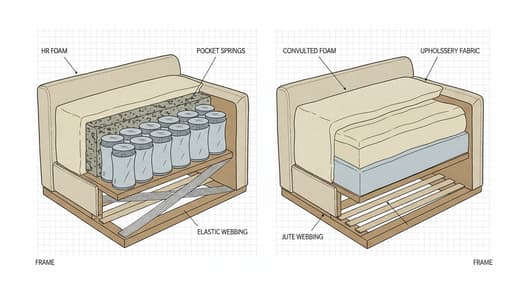
Foam Replacement vs Complete Sofa Upholstery: Which One Do You Actually Need?
When your sofa stops feeling like it used to, the real question is whether the problem lives inside the cushions or in the fabric — and getting that diagnosis wrong costs you money. This guide breaks down exactly when foam replacement alone is enough, when full upholstery is the smarter call, and what foam densities and grades actually mean for long-term comfort. By the end, you will know precisely which service your sofa needs.
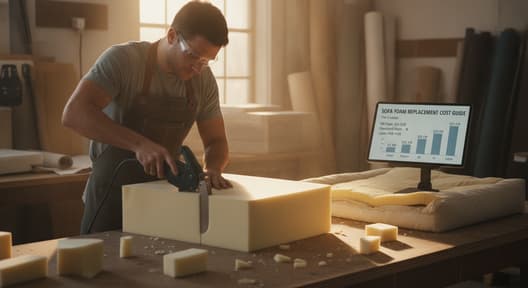
Sofa Foam Replacement Cost Guide: Everything Homeowners Should Know
Sofa foam replacement cost in Delhi NCR ranges from ₹800 per cushion to ₹14,000 for a full L-shape sofa — but the right foam density matters as much as the price. This guide breaks down every cost variable, from foam type and ILD rating to labour and Dacron wrapping, so you know exactly what you're paying for before booking a technician.
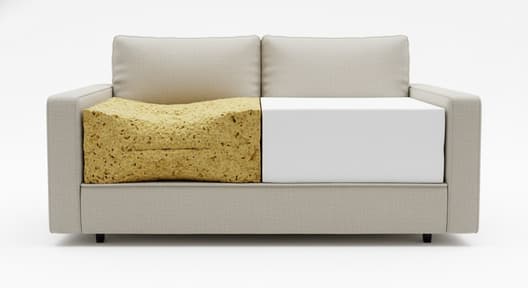
Best Sofa Foam for Delhi Climate: Complete Buying Guide
Delhi's extreme heat, dry winters, and humid monsoons destroy cheap sofa foam fast. Learn which foam density and type will keep your sofa comfortable for years.
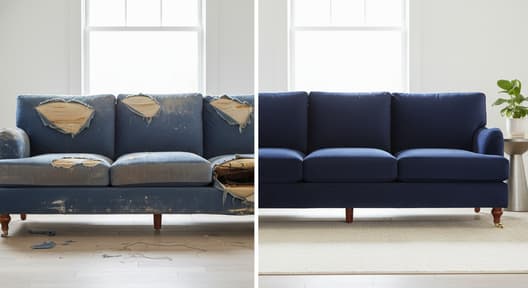
Furniture Repair vs Replace: Which Is the Smarter Choice?
Torn between repairing and replacing your old furniture? This guide compares real costs and helps you decide what makes sense for your budget and your home.