Custom Furniture Repair Faridabad
Specialist restoration for custom-built, handmade, and modified furniture. Faridabad's premium residential communities rely on FurniRevive for repairs that respect original craftsmanship and personal design choices.
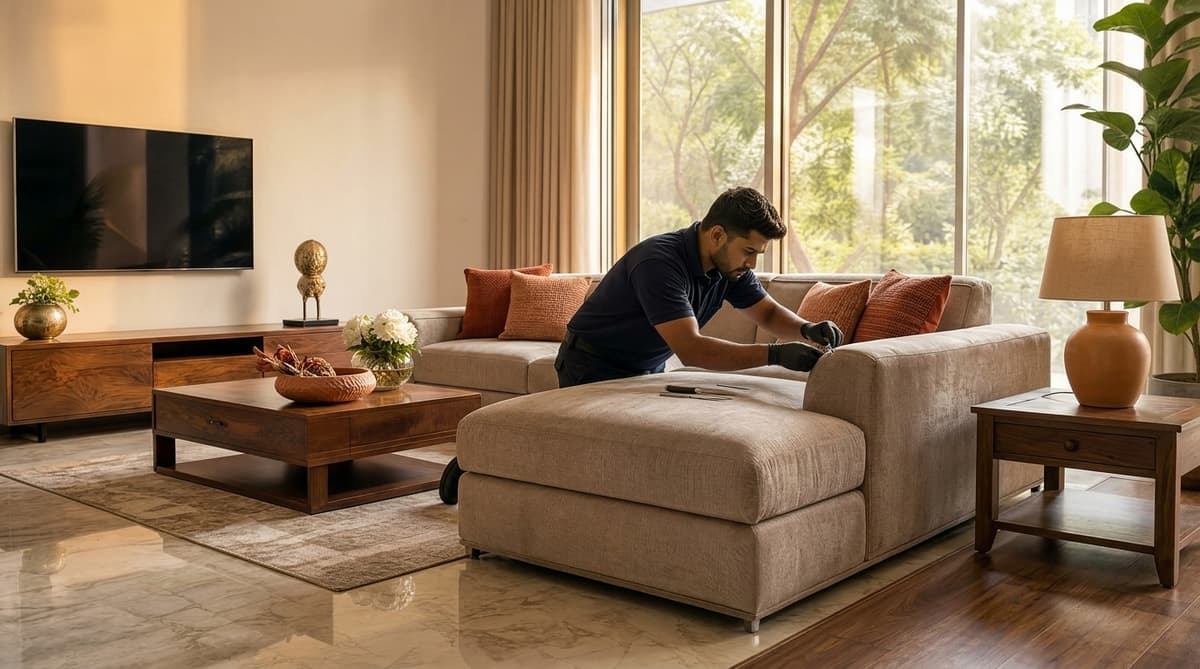
Custom Furniture Repair in Faridabad | Premium upholstery & foam service | Home visit | FurniRevive
Quick Answer
FurniRevive repairs custom-built and handmade furniture throughout Faridabad — including one-of-a-kind pieces, locally commissioned work, and furniture built to bespoke specifications. We offer collection and delivery across all premium sectors and communities.
Trusted by thousands of families across Faridabad, FurniRevive is the go-to choice for dependable, quality furniture repair with a warranty you can count on.
Custom furniture occupies a unique and complex position in the furniture repair world. These are pieces that were built to a brief — a homeowner's specific dimensions, a design instruction from an architect, a material combination that no catalogue offered. They have no spare parts, no replacement cushions, no manufacturer's service department. When they fail — and with daily use, all furniture eventually needs attention — the only path forward is a craftsperson who can understand what the original maker intended and replicate that quality in the repair. This is the core of what FurniRevive does for custom furniture owners across Faridabad.
The custom furniture landscape in Faridabad is diverse. At one end are pieces commissioned from established furniture workshops in Delhi or imported from artisan makers abroad — pieces with significant financial and aesthetic value. At the other end are pieces built by skilled local carpenters to a homeowner's specification — high-quality work done at Faridabad prices. Both categories share the essential characteristic of custom furniture: they cannot be simply replaced from a showroom. When the marble-topped dining table a Sector 46 villa owner commissioned from a Delhi workshop develops a structural issue, or when the custom-dimensioned bookshelf unit in a BPTP Parklands apartment loses its finish, the repair must meet the standard of the original work.
FurniRevive has built its custom furniture repair capability around two core competencies: the ability to reverse-engineer what we did not build, and the material access to replicate it faithfully. Our craftspeople approach every custom piece by first understanding its construction — how it was put together, what materials were used, and what the original maker was trying to achieve. That understanding informs every subsequent decision: what adhesives to use on what joint, which timber to source for a patch, how to replicate a hand-applied finish that the original carpenter mixed from a personal recipe.
For Faridabad homeowners specifically, access to this level of repair has historically meant either finding the original maker (not always possible), or commissioning a Delhi-based specialist at considerable cost and logistics inconvenience. FurniRevive provides a direct local solution — a team with the skills to work on genuinely custom pieces, operating from and serving the Faridabad market. Whether your custom piece is a built-in wardrobe in Sector 21C, a freestanding carved cabinet in Omaxe Heights, or a custom upholstered headboard in RPS Savana, we have both the skills and the proximity to repair it correctly.
With rising furniture prices across Delhi NCR, residents in Faridabad increasingly turn to professional repair as the smart, economical alternative to buying new.
Sofa Repair Near Me in Faridabad
A FurniRevive technician reaches Faridabad within 2–4 hours.
Searching for reliable sofa repair near me in Faridabad? FurniRevive provides doorstep sofa repair at your residential locality with a 2–4 hours technician response across Faridabad. We bring everything needed — high-density foam, matching fabric, recliner parts, webbing springs — to complete home sofa repair right in your living room. From torn fabric and sagging cushions to cracked leather and broken frames, we repair all sofa types: fabric, leather, wooden, recliner, and sofa cum bed.
Whether your sofa has a sagging seat from flat foam, needs sofa spring repair, sofa frame repair, recliner mechanism work, or torn sofa repair for fabric or leather, our same-day sofa repair service in Faridabad handles it all. Sofa repair price in Faridabad starts at ₹500 per seat with a free doorstep inspection included. Book a sofa technician near you today — all repairs come with a 6-month warranty.
Sofa Repair Service in Faridabad and Nearby Areas
Fastest response near Crown Interiorz Mall, YMCA Chowk, Surajkund Crafts Mela Ground. Our locally stationed technicians complete sofa repair in Faridabad every day — at apartments, independent houses, offices, and restaurants alike. Transparent pricing starting ₹500 with a free doorstep inspection before any work begins.
Frequently Asked Questions — Faridabad
- How much does sofa repair cost in Faridabad?
- Sofa repair cost in Faridabad starts at ₹500 for basic cushion work. Foam replacement is ₹999–₹2,500 per seat, fabric re-upholstery from ₹2,000 per seat, leather sofa repair from ₹1,500, and full set restoration from ₹8,000. FurniRevive provides a free doorstep inspection before any work begins — no obligation, no hidden charges.
- Is the doorstep inspection free in Faridabad?
- Yes, FurniRevive offers a completely free doorstep inspection in Faridabad. Our technician visits your home, diagnoses the sofa thoroughly, and provides a detailed itemised quote — no obligation, no call-out fee. Repair work only begins after you approve the quote.
- Is there a warranty on sofa repair in Faridabad?
- All repairs completed in Faridabad are backed by a 6-month written warranty. It applies to every job — from a single cushion foam replacement to a full 5-seater restoration. Contact us within the warranty period for any covered issue and our technician returns for free.
- Do you offer same-day sofa repair in Faridabad?
- Same-day doorstep sofa repair in Faridabad is available when you book early in the day. WhatsApp us photos of the damage at +91 92179 99355 and we'll confirm a same-day slot. For urgent jobs, calling directly is faster than the online form.
- How long does a sofa technician take to reach Faridabad?
- Our nearest sofa technician reaches your address in Faridabad within 2–4 hours in most cases. For early-morning bookings, the technician often arrives within 1–2 hours. WhatsApp +91 92179 99355 with your pincode or society name for the most accurate estimate.
- Which areas near Faridabad do you service?
- FurniRevive covers Faridabad and the surrounding Faridabad areas under a single, consistent pricing structure. Our technicians don't charge extra for travelling between sectors or neighbouring colonies. Confirm your specific address by calling 92179 99355 or WhatsApp-ing +91 92179 99355.
- How do I know if my sofa is worth repairing or should be replaced in Faridabad?
- For sofa owners in Faridabad, the repair-vs-replace decision comes down to frame quality and budget. A solid frame can be fully restored — new foam, springs, and fabric — for ₹12,000–₹22,000, saving 60–70% over a new sofa. FurniRevive's free inspection gives you an honest assessment with no sales pressure to repair.
Why Choose FurniRevive?
Reverse-Engineering Expertise
We analyse how your custom piece was built before we touch it — studying joinery methods, material choices, and construction sequence. This lets us repair faithfully rather than generically.
No Templates, No Shortcuts
Custom furniture was built without templates. Our repairs follow the same principle — every repair is designed around the specific piece, not adapted from a standard approach that mostly fits.
Timber and Material Sourcing
We maintain relationships with specialist timber merchants and material suppliers across Delhi NCR. When a custom piece requires a specific timber species, hardware type, or fabric not available in standard supply, we source it rather than substitute.
Modifications and Upgrades
Custom furniture can be modified as well as repaired. We handle requests to adapt dimensions, add or remove storage, change upholstery, upgrade hardware, or modify finishes — all while preserving the piece's structural integrity and design character.
Works Alongside the Original Maker
Where the original carpenter or designer is available, we welcome their involvement. We can work from original drawings, specifications, or the maker's direct input to ensure repairs meet the original standard.
Full-Service: Collection to Reinstallation
We collect, repair, and reinstall custom pieces across Faridabad. For built-in or fixed furniture, we work in situ. For freestanding pieces, we transport to our workshop and return with care appropriate to the piece.
Our Repair Process
Piece Documentation and Construction Analysis
Our technician photographs and measures every aspect of the piece before assessment begins. We examine joinery types, timber species, finish layers, hardware, and upholstery construction. This analysis is the foundation of every repair decision that follows.
Damage Assessment and Repair Planning
We document the damage in detail — distinguishing between immediate repair needs, latent issues that should be addressed simultaneously, and areas that are showing early wear but are not yet problematic. We discuss all categories with you and agree the scope before quoting.
Material Sourcing
For custom pieces, material sourcing often precedes workshop repair. We identify the specific timber, hardware, fabric, or finish materials required and source them before work begins. We do not start repairs and then discover materials are unavailable.
Workshop or In-Situ Repair
Most freestanding custom pieces are repaired at our workshop where we have the full range of tools and materials available. Built-in furniture and very large or fixed pieces are repaired in situ at your home. We coordinate access requirements in advance.
Finishing and Matching
Surface finishing is the final workshop stage and the most visible indicator of repair quality. We match the existing finish in type, sheen level, colour, and application texture. For hand-applied finishes, we replicate the application method rather than substituting a spray finish.
Delivery, Reinstallation, and Client Review
We return the piece to its position, reinstall any components removed during repair, and walk through the work with you. We do not consider a job complete until you have reviewed the repair and confirmed your satisfaction.
Why Custom Furniture Requires Specialist Repair
The defining characteristic of custom furniture — that it was built to a specific brief rather than manufactured to a standard specification — is precisely what makes its repair challenging. A standard production sofa can be repaired using replacement parts sourced from the manufacturer. A custom sofa has no parts catalogue. The foam density was chosen for this specific design. The fabric came from a batch that may no longer exist. The frame joinery was executed by a specific carpenter whose style and technique are embedded in the construction. Repair requires understanding all of this before a single component is touched.
Custom furniture also tends to reflect higher original craft standards than comparable production pieces. A carpenter who builds custom furniture for a villa owner in Sector 46 or a penthouse in BPTP Parklands brings personal pride and professional reputation to the work. The joinery is more carefully fitted, the surfaces are more attentively finished, and the proportions are more precisely calibrated to the space and use. Repair work on these pieces must match that standard. A patch applied with the wrong technique or a finish touched up in the wrong sheen class is immediately visible against work of original quality.
There is also the question of design integrity. Custom furniture was designed — even if informally — as part of a space. Its dimensions relate to the room's proportions. Its material palette relates to other elements in the interior. When it is repaired with incompatible materials, the repair damages not just the piece but the room it occupies. This is a context that standard repair services do not typically consider, but which matters considerably to homeowners who have invested in a considered interior environment.
FurniRevive approaches custom furniture repair as a continuation of the original craft process. We do not repair against a generic standard — we repair against the specific piece in front of us, aiming for an outcome where the repair is invisible and the piece performs as intended. This is a demanding standard. It requires more time, more careful material selection, and more experienced craftspeople than standard furniture repair. But it is the only standard that is appropriate for custom work.
Common Problems with Custom-Built Furniture
Joint failure is the most common structural issue in custom furniture, and its causes vary by construction method. Mortise-and-tenon joints, used in quality solid wood furniture, fail when the adhesive degrades — often accelerated by Faridabad's climate cycling between very dry summers and humid monsoons. Dowel joints fail when the dowels are too small for the load or when the adhesive was insufficiently applied at the time of construction. Biscuit joints, popular in furniture built from sheet goods, are prone to delamination when the biscuit absorbs moisture and swells beyond its original compressed profile.
Timber movement is a particular challenge in custom furniture built from solid wood. All timber moves with changes in ambient humidity — expanding when humid, contracting when dry. Well-designed furniture accommodates this movement through floating panels, expansion gaps, and joinery that allows seasonal movement without failure. Poorly designed or poorly executed custom furniture resists this movement, resulting in cracked panels, blown joints, and warped components over time. Understanding whether a crack or warp is a failure or expected movement determines the repair approach.
Finish degradation on custom furniture reflects both the quality of the original finish and the conditions it has been exposed to. Hand-rubbed oil finishes on solid timber require periodic re-oiling to remain protective and attractive. Water-based lacquers yellow at joints and edges under UV exposure. Painted finishes chip at handles, corners, and drawer front edges. Surface finishes on custom furniture are often unique — mixed by the original carpenter, applied in an unusual sequence, or chosen from a non-standard product — which requires investigation to match correctly.
Upholstery failure on custom pieces often involves non-standard components. A custom sofa may have been built with unusual foam density combinations, non-standard cushion profiles, or upholstery construction techniques that reflect the maker's specific approach rather than standard trade practice. When reupholstering these pieces, the challenge is not just the fabric selection but understanding and replicating the underlying construction. Our craftspeople approach custom upholstery with the same analytical discipline as custom woodwork — studying the original before deciding the approach.
Signs Your Custom Piece Needs Specialist Attention
Structural signs to watch for include: any visible movement in joints when the piece is used — a dining table that rocks, a chair that twists when you sit, a cabinet whose doors have shifted alignment; audible creaking or cracking during normal use; visible gaps at joints that were previously tight; and any component separation (panel pulling away from frame, tabletop separating from base) that was not present when the piece was new.
Surface and finish signs include: crazing or cracking of lacquer or paint finish, particularly at joints and edges; water rings, stains, or discolouration that has penetrated the finish layer; peeling or bubbling of veneer or surface material; and uneven sheen — areas where the finish has worn through to bare timber or underlying layers. These issues are progressive — an unaddressed crack in a lacquer finish admits moisture, which accelerates deterioration of both the finish and the timber beneath.
Upholstery warning signs include: sagging or asymmetric cushion profiles, fabric pulling away at seams or edges, visible wear through on high-contact areas, and any change in the seating feel that was not present originally. For upholstered headboards, benches, and ottomans, watch for fabric loosening at the back or underside where stapling or tacking has released. Catching these early is far less expensive than a full reupholstery.
Functional signs — drawers that bind or have excessive play, doors that do not close flush, extending or folding mechanisms that have stiffened or loosened — often indicate hardware failure or timber movement that has exceeded design tolerances. These functional issues are worth addressing promptly because they tend to worsen with continued use and the forces applied when operating a stiff mechanism will eventually cause structural damage beyond the hardware itself.
Custom Furniture Repair Services
Structural repair encompasses all types of frame and joint work for custom furniture. We work with solid hardwood, softwood, sheet goods (MDF, plywood, birch ply), and composite constructions. Joint repairs range from simple re-gluing of separated mortise-and-tenon joints to more complex interventions where a failed joint has caused secondary damage to adjacent timber. We use the joinery method that best suits the original construction — we do not insert modern metal fasteners into furniture designed for traditional joinery unless there is a structural necessity and the client understands the intervention.
Timber repair covers both structural and cosmetic timber work. Structural timber repair includes replacing damaged or failing components with matched-species timber, reinforcing areas subject to recurrent stress, and correcting movement-related distortion through careful reshaping and refinishing. Cosmetic timber repair includes scratch and dent removal, crack filling with tinted wood filler or epoxy, and grain-matched patching for areas of significant surface damage. We aim for invisibility on all cosmetic timber repairs.
Custom upholstery work is one of our strongest capabilities for custom furniture. We offer full reupholstery in client-supplied or FurniRevive-sourced fabric, partial panel replacement for localised damage, cushion refoaming using density-matched profiles, and dacron re-wrapping for seat and back cushions that have lost their original profile. For headboards, banquettes, window seats, and other architectural upholstery, we work in situ where removal is impractical.
Hardware service and replacement covers all types of custom furniture hardware including hinges, drawer slides, handles, locks, and decorative metalwork. We source matching or compatible hardware through our suppliers and, where original hardware is irreplaceable, offer refinishing or reproduction as alternatives. Drawer mechanism service — removing, cleaning, lubricating, adjusting, or replacing drawer slides — is one of the most commonly requested services for older custom storage furniture.
Modifications and Upgrades to Custom Furniture
One of the significant advantages of custom furniture is that it can be modified. Unlike production furniture with fixed dimensions and specifications, custom pieces can be adapted as the owner's needs change. A dining table can be extended or shortened. A storage unit can have shelves added or removed. A bed frame can have a different headboard fitted. A wardrobe can be reconfigured internally. FurniRevive undertakes these modifications alongside or independently from repair work.
Dimension modifications are the most common request. A dining table that was sized for a previous home may need to be shortened for a new space. A bookshelf unit that previously filled one wall may need adaptation to fit a different wall configuration. We can reduce, extend, and reconfigure solid timber and sheet-goods furniture with appropriate structural reinforcement and surface matching. We do not guarantee invisibility on major dimension changes, but we minimise evidence of modification through careful work.
Finish upgrades are requested regularly — particularly for pieces where the original finish has aged, yellowed, or become practically inconvenient. A hand-oiled surface that requires too-frequent maintenance can be converted to a hard wax oil finish that offers better practical protection. A painted surface in an outdated colour can be professionally repainted in a current colour with appropriate surface preparation. A lacquered surface can be refreshed or changed in sheen level.
Upholstery upgrades — changing fabric, changing leather, changing cushion profiles, or adding upholstered elements to previously unupholstered pieces — are requested both for aesthetic and practical reasons. A sofa bought in a fabric that no longer suits the room's direction can be reupholstered in a new fabric that reflects the current interior. A dining chair with a hard seat can have an upholstered pad fitted. These upgrades extend the useful life of custom pieces while refreshing the interior.
Repair vs Replacement for Custom Furniture
For custom-built furniture, the replacement question is more pointed than for standard production pieces: you cannot simply order an identical replacement. The options are commissioning a new custom piece, buying a production alternative that may not match your space or specification, or repairing the existing piece. In most cases, repair is the clear choice — not just financially, but because the custom piece was designed for your space and represents a specific investment in that design.
The financial arithmetic for custom furniture repair is also generally compelling. Quality custom furniture is expensive to build — a custom solid timber dining table for a Sector 46 villa or a BPTP Parklands apartment might have cost ₹1.5 lakh to ₹3 lakh when commissioned. Repairing it, even comprehensively, is unlikely to cost more than 30–40% of that original price unless the damage is exceptional. Commissioning a replacement would cost at least as much as the original and involve significant lead time.
The cases where replacement makes more sense than repair are: where the custom piece was originally built to a lower quality standard and has reached the end of its practical life; where the owner's needs or space have changed so fundamentally that the piece's original design is no longer appropriate regardless of condition; or where damage is so severe — fire damage, flood damage, major pest damage — that structural restoration is impractical or would leave the piece below an acceptable standard of safety and longevity.
We provide honest assessments. When we examine a custom piece, we tell the owner what is achievable through repair and what the realistic outcome looks like — we do not oversell repair on pieces that are genuinely beyond economic or practical restoration. When repair makes sense, we say so and explain why. When it does not, we say that too, and often help owners think through commissioning replacement work with appropriate quality standards.
Serving Faridabad's Premium Custom Furniture Owners
Custom furniture is particularly prevalent in Faridabad's villa and large independent house belt — the sectors running from Sector 15 through to Sector 49, where properties have the space to accommodate bespoke built-in storage, large custom dining furniture, and room-specific commissioned pieces. These homeowners typically engaged carpenters or furniture studios for complete-room furniture specifications during the fit-out of their homes, and now need a repair partner who can maintain that quality level.
The newer premium apartment communities in Greater Faridabad — BPTP Parklands, Omaxe Heights, RPS Savana, Puri Pranayam, Emerald Heights — represent a different custom furniture profile. Here, the custom pieces are often statement items: a custom upholstered headboard, a bespoke media unit, a commissioned display cabinet. These pieces sit against standard furniture and must therefore be maintained at their original quality level to anchor the room's composition effectively.
SRS Residency, BPTP Elite Floors, and Puri Aman Vilas residents represent a third profile — premium flats where complete furniture programmes were commissioned during initial fit-out. Wardrobes, kitchen cabinetry, dining furniture, and study units were all custom-built to the apartment's specific dimensions and the owner's specifications. Maintaining these programmes as a coherent whole is important — a repaired dining chair should match its set exactly, not be visibly different from the five chairs around it.
We cover all of these communities with the same service standard. Collection times are coordinated to suit residents' schedules. Our team is presentable, professional, and familiar with working in premium residential environments. We understand that furniture repair in a premium home is a disruption, and we manage that disruption to be as brief and unobtrusive as possible.
Case Studies: Custom Furniture Restored
A resident at BPTP Parklands contacted us about a custom teak bookshelf unit that had been built to floor-to-ceiling height across an entire wall. Several shelves had bowed under load, two vertical uprights had developed significant movement cracks, and the entire unit was beginning to pull away from the wall fixing at the top. We assessed that the unit had been built without adequate vertical support dividers for the shelf span. Our repair involved adding invisible centre supports to four shelves, reinforcing both cracked uprights with timber splints concealed within the unit's back panel, re-fixing the top plate to the wall with appropriate fixings, and refinishing all repaired surfaces in matching teak oil. The unit now performs structurally as the owner intended.
A villa owner in Sector 29 brought us a set of eight custom solid sheesham dining chairs — a major commission from a local carpenter three years earlier — of which three had developed loose back splats and two had seat drop-ins that had failed. All eight chairs were collected together. We re-glued and re-pegged all loose back splat joints on the three affected chairs, replaced the webbing and foam in two drop-in seats, reupholstered both in matching fabric sourced from the original supplier (available through trade channels), and oiled all eight chairs uniformly so the set remained visually consistent. The owner confirmed the set looked like new.
An Omaxe Heights resident had commissioned a custom upholstered headboard for a master bedroom — a large format piece with a buttoned velvet face and a timber internal frame — that had developed serious fabric loosening and three broken button ties. The headboard was too large to transport easily, so we repaired it in situ. We re-tensioned and re-stapled the fabric at all loose edges, replaced all broken button ties using matching thread, and spot-cleaned the velvet face. The repair was completed within a single day visit.
Working with Original Makers and Designers
For custom furniture with an original maker still in practice, we encourage a collaborative approach to repair. The maker knows what they built, what materials they used, and what their intentions were. Their involvement in the repair assessment — even if only through a brief conversation or the provision of original drawings or specifications — significantly improves our ability to replicate their work accurately.
We have established working relationships with several furniture workshops and interior design studios who commission custom furniture for their Faridabad and Greater NCR clients. These relationships mean that when one of their commissioned pieces requires repair, they can direct their client to us with confidence that we will handle it appropriately. We treat these referral relationships with care — we repair to the original maker's standard, not a different standard, and we never suggest to a shared client that the original work was substandard unless there was a genuine defect that caused the damage.
For pieces where the original maker is not available — perhaps a small workshop that has closed, a carpenter who has moved on, or imported furniture without local service support — we reverse-engineer the construction from the piece itself. This is a more time-consuming process and may result in minor interpretation differences, but our goal remains faithfulness to the original intent. We document our findings and decisions thoroughly so that any future repair can build on our work.
In-Situ Repair for Built-In Custom Furniture
A significant category of custom furniture — wardrobes, kitchen units, built-in shelving, banquettes, window seats, built-in desks and study units — cannot be removed for workshop repair. These pieces are structurally integrated with the room, fixed to walls, or simply too large and complex to transport. FurniRevive provides full in-situ repair capability for these pieces.
In-situ repair requires a different set of logistics than workshop repair. We bring the tools and materials to the home rather than the furniture to the workshop. This requires more careful preparation: a full material list must be prepared and sourced before the visit, tools must be appropriate for working within finished rooms, and dust and debris management must be active throughout to protect surrounding surfaces and furnishings.
The range of in-situ repairs we can perform is nearly complete: joint repair and reinforcement, surface finishing, hardware replacement, drawer mechanism service, upholstery in place, panel replacement for damaged sections. The few things that cannot easily be done in situ — such as full immersion finishing or work requiring workshop equipment — we plan around, carrying out those components either on removable sub-assemblies or through a sequence of site visits.
For built-in furniture in Faridabad's premium apartments — where rooms are typically smaller and more fully furnished than in villas — our in-situ team is specifically trained to work efficiently in confined spaces without causing collateral damage. We use drop sheets and masking throughout, maintain a clean working environment, and leave no trace of having been there beyond the repaired furniture.
Pricing for Custom Furniture Repair in Faridabad
Custom furniture repair pricing reflects the specific work required rather than a standard rate. The primary cost drivers are labour complexity — how technically demanding the repair is and how experienced a craftsperson it requires — and materials, which for custom pieces may need to be specially sourced. Both are itemised separately in our written quotations.
Labour for custom furniture repair is priced at a higher rate than standard repair because it requires more experienced craftspeople and more time per unit of work. Analysing an unfamiliar construction, sourcing materials that are not standard stock, and executing a repair that must match the standard of original custom work all take more care and time than standard production furniture repair. This is reflected in our pricing transparently.
Material costs for custom furniture vary widely. Solid timber in uncommon species can cost significantly more than standard hardwoods. Premium fabrics and leathers sourced for a specific match carry a premium over standard grades. Specialist hardware for reproduction or matching purposes may need to be imported. We provide the actual material cost in quotations rather than a mark-up estimate.
As a general guide, custom furniture repairs in Faridabad through FurniRevive range from ₹8,000 for minor single-element work to ₹2 lakh or more for comprehensive restoration of complex large pieces. All quotes are provided in writing after assessment and are fixed unless scope changes are agreed with the client. There are no surprises on final billing.
Our craftsmen arrive with 200+ hardware items, 400+ fabric swatches, and professional tools — fully equipped for any Faridabad repair.
Key Benefits
- Restore one-of-a-kind pieces that cannot be replaced from a showroom or catalogue
- Preserve the specific dimensions, materials, and design choices that make custom furniture valuable
- Access specialist repair in Faridabad without the cost and complexity of Delhi logistics
- Repairs that replicate original craftsmanship rather than applying a generic fix
- Opportunity to modify or upgrade during repair — changing dimensions, finishes, or upholstery
- Transparent written assessment and quotation before any work begins
- Timber and material sourcing through specialist suppliers not available to general repairers
- Structural repairs that extend the service life of well-built custom pieces significantly
- Expert advice on preventive maintenance for custom furniture in Faridabad's climate
- Full documentation of repairs for insurance, provenance, or future repair reference
Real Repair Results in Delhi/NCR
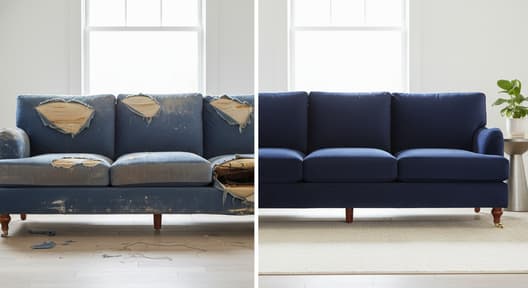
See actual before and after transformations by our skilled craftsmen across Delhi/NCR.
Service Areas in Faridabad
We provide doorstep furniture repair services across Faridabad including:
Frequently Asked Questions
Related Pages
Helpful Guides & Tips
10 Common Furniture Problems & How to Fix Them
From sagging sofa cushions to wobbly dining tables, here are the 10 most common furniture problems Indian homeowners face — and exactly how to solve each one.
DIY Furniture Repair Tips for Delhi NCR Homes — When to DIY vs Call a Pro
Not every furniture problem needs a professional — but some absolutely do. This guide draws a clear line between safe DIY fixes and jobs that will cost you more if you attempt them yourself.
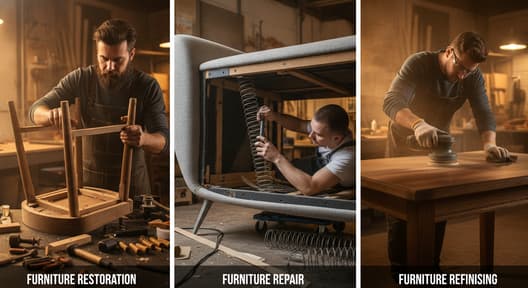
Furniture Restoration vs Furniture Repair vs Furniture Refinishing: What's the Difference?
Furniture repair, refinishing, and restoration are three different services with very different scopes, costs, and outcomes — yet most homeowners use the terms interchangeably and end up booking the wrong one. This guide explains precisely what each service covers, how much it costs in India, and how to choose the right one for your piece.
Furniture Repair vs Replace: Which Is the Smarter Choice?
Torn between repairing and replacing your old furniture? This guide compares real costs and helps you decide what makes sense for your budget and your home.