Expert Leather Sofa Restoration on Noida Expressway
The Noida Expressway corridor — Sectors 104, 107, 137, 143, and 150 — houses some of Delhi NCR's most premium apartment residences. FurniRevive brings specialist-grade leather sofa restoration to your doorstep across the full Expressway residential zone from ₹999. Professional colour matching, crack repair, imported sofa specialists. 6-month warranty.
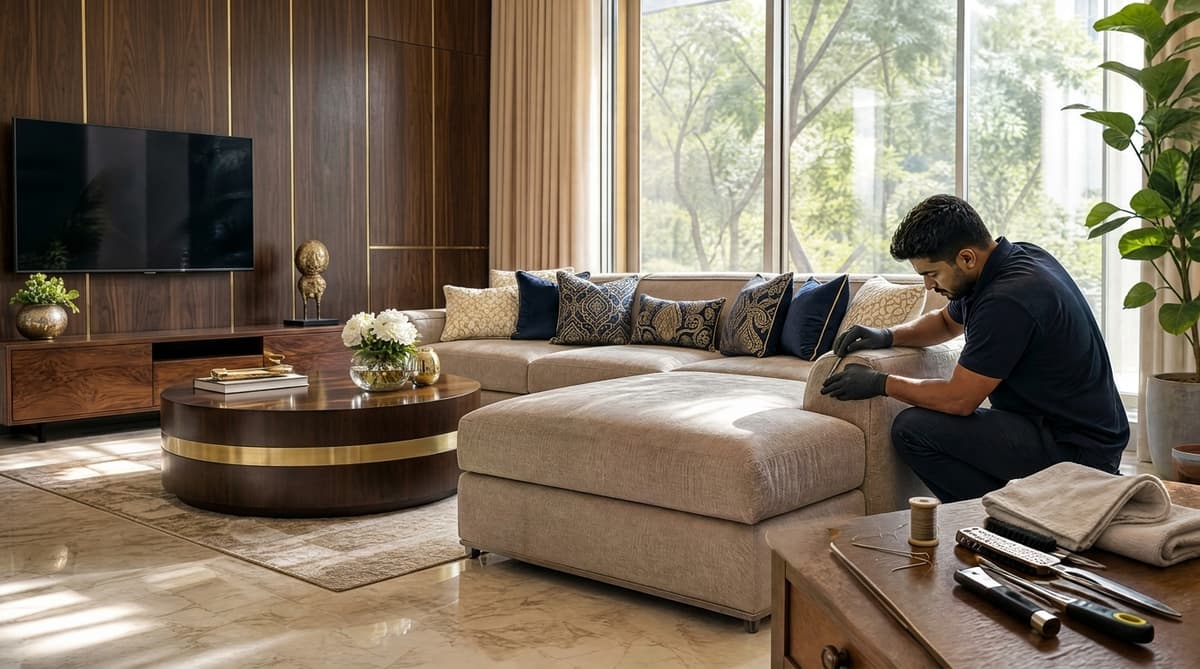
Leather Sofa Repair on Noida Expressway | Premium restoration & colour matching | Home visit | FurniRevive
Quick Answer
FurniRevive delivers premium leather sofa restoration across the Noida Expressway corridor — covering Sector 104, Sector 107, Sector 137, Sector 143, and Sector 150 — from ₹999. Our specialist craftsmen restore Italian and imported leather sofas, handle professional colour restoration, treat AC-induced cracking, and repair recliner leather wear. Free assessment, fixed pricing, and a 6-month warranty on every restoration.
Choosing sofa repair in Leather Sofa Repair expressway, Noida over buying new isn't just budget-friendly — it's an eco-conscious decision that keeps quality furniture out of landfills.
The Noida Expressway corridor has become one of Delhi NCR's most significant premium residential addresses over the past decade — a linear zone of high-rise towers and gated societies that houses a demographically distinctive combination of IT professionals, senior corporate executives, and international-posting returnees whose furniture often tells the story of homes maintained at a high standard. Sector 104's ATS One Hamlet families brought Italian leather sectionals when they moved in. Sector 143's Expressway-view tower residents purchased premium recliners from NCR showrooms for their work-from-home setups. Sector 150's larger apartments contain furniture that was chosen as carefully as the flat itself. These pieces deserve leather restoration at a professional standard — and that is specifically what FurniRevive provides.
Our Noida Expressway leather restoration service covers the full corridor — Sector 104, Sector 107, Sector 137, Sector 143, and Sector 150 — under a single service operation linked to the broader leather sofa repair Noida zone. Our craftsmen are trained in the full spectrum of leather restoration required by Expressway corridor furniture: full-grain and semi-aniline Italian leather care, professional colour-matching using a 40+ pigment tinting system, specialist crack-filling compound application for AC-induced cracking, and recliner leather wear treatment specific to the work-from-home usage patterns common in this sector group.
Starting at ₹999 with no Expressway corridor premium, the free on-site assessment generates a fixed, itemised quote before any work begins. Our service vehicle carries a complete leather restoration kit alongside foam grades, fabric swatches, and recliner mechanism components — so most Expressway corridor leather restorations complete in a single visit without a workshop trip. For the Expressway's professionals who manage their time carefully, this single-visit efficiency — whether for a leather restoration or a combined leather-and-recliner appointment with our recliner repair Noida Expressway team — is a deliberate design choice.
Homes in Leather Sofa Repair expressway, Noida often deal with furniture wear caused by seasonal humidity changes, heavy daily use, and the compact apartment layouts typical of Delhi NCR.
Services Available in Leather Sofa Repair expressway, Noida
Sofa Repair Near Me in Leather Sofa Repair expressway
A FurniRevive technician reaches Leather Sofa Repair expressway within 2–4 hours.
Searching for reliable sofa repair near me in Leather Sofa Repair expressway? FurniRevive provides doorstep sofa repair at your residential locality with a 2–4 hours technician response across Noida. We bring everything needed — high-density foam, matching fabric, recliner parts, webbing springs — to complete home sofa repair right in your living room. From torn fabric and sagging cushions to cracked leather and broken frames, we repair all sofa types: fabric, leather, wooden, recliner, and sofa cum bed.
Whether your sofa has a sagging seat from flat foam, needs sofa spring repair, sofa frame repair, recliner mechanism work, or torn sofa repair for fabric or leather, our same-day sofa repair service in Leather Sofa Repair expressway handles it all. Sofa repair price in Leather Sofa Repair expressway starts at ₹500 per seat with a free doorstep inspection included. Book a sofa technician near you today — all repairs come with a 6-month warranty.
Sofa Repair Service in Leather Sofa Repair expressway and Nearby Areas
Fastest response near Botanical Garden Metro, Atta Market, DLF Mall of India. Our locally stationed technicians complete sofa repair in Noida every day — at apartments, independent houses, offices, and restaurants alike. Transparent pricing starting ₹500 with a free doorstep inspection before any work begins.
Frequently Asked Questions — Leather Sofa Repair expressway
- How much does sofa repair cost in Leather Sofa Repair expressway?
- Sofa repair cost in Leather Sofa Repair expressway starts at ₹500 for basic cushion work. Foam replacement is ₹999–₹2,500 per seat, fabric re-upholstery from ₹2,000 per seat, leather sofa repair from ₹1,500, and full set restoration from ₹8,000. FurniRevive provides a free doorstep inspection before any work begins — no obligation, no hidden charges.
- Is the doorstep inspection free in Leather Sofa Repair expressway?
- Yes, FurniRevive offers a completely free doorstep inspection in Leather Sofa Repair expressway. Our technician visits your home, diagnoses the sofa thoroughly, and provides a detailed itemised quote — no obligation, no call-out fee. Repair work only begins after you approve the quote.
- Is there a warranty on sofa repair in Leather Sofa Repair expressway?
- All repairs completed in Leather Sofa Repair expressway are backed by a 6-month written warranty. It applies to every job — from a single cushion foam replacement to a full 5-seater restoration. Contact us within the warranty period for any covered issue and our technician returns for free.
- Do you offer same-day sofa repair in Leather Sofa Repair expressway?
- Same-day doorstep sofa repair in Leather Sofa Repair expressway is available when you book early in the day. WhatsApp us photos of the damage at +91 92179 99355 and we'll confirm a same-day slot. For urgent jobs, calling directly is faster than the online form.
- How long does a sofa technician take to reach Leather Sofa Repair expressway?
- Our nearest sofa technician reaches your address in Leather Sofa Repair expressway within 2–4 hours in most cases. For early-morning bookings, the technician often arrives within 1–2 hours. WhatsApp +91 92179 99355 with your pincode or society name for the most accurate estimate.
- Which areas near Leather Sofa Repair expressway do you service?
- FurniRevive covers Leather Sofa Repair expressway and the surrounding Noida areas under a single, consistent pricing structure. Our technicians don't charge extra for travelling between sectors or neighbouring colonies. Confirm your specific address by calling 92179 99355 or WhatsApp-ing +91 92179 99355.
- How do I know if my sofa is worth repairing or should be replaced in Leather Sofa Repair expressway?
- For sofa owners in Leather Sofa Repair expressway, the repair-vs-replace decision comes down to frame quality and budget. A solid frame can be fully restored — new foam, springs, and fabric — for ₹12,000–₹22,000, saving 60–70% over a new sofa. FurniRevive's free inspection gives you an honest assessment with no sales pressure to repair.
Nearby Areas We Serve
We provide doorstep sofa repair across these nearby areas in the same zone.
Why Choose FurniRevive?
Expressway Corridor Specialists — We Know the Furniture Profile
The Expressway corridor's leather sofas skew toward premium and imported — a direct reflection of its IT-and-corporate professional demographic. Our craftsmen are trained specifically in the Italian, European, and Korean import leather grades most common in Sectors 104, 107, 137, 143, and 150 apartments, not in the generic corrected-grain and bonded leather of mass-market furniture repair.
AC-Induced Crack Treatment — Expressway's Most Common Problem
Expressway corridor apartments are among the most heavily air-conditioned residential spaces in Delhi NCR — ACs running 10–14 hours daily for nine months of the year. This creates the most hostile environment for leather in the NCR. Our craftsmen are specifically trained in the crack profiles and treatment approaches for AC-induced leather deterioration, not the UV-plus-AC combined damage pattern of South Delhi or the heritage leather profile of DLF Phase 1.
Work-From-Home Recliner Leather — Expressway's Specific Wear Pattern
Sector 143's work-from-home concentration and Sector 104's recliner ownership rate create a specific leather wear pattern — concentrated at the seat-front edge, both armrests, and headrest — that represents both the most common restoration request and a distinctive technical challenge. We address this through targeted conditioning and colour restoration at the friction points alongside mechanism assessment.
Same-Day Restoration Across the Full Expressway Corridor
Morning bookings before noon receive same-day afternoon slots across Sectors 104, 107, 137, 143, and 150. One service zone, one call, same-day availability across the full corridor.
Society Access — ATS One Hamlet and All Expressway Gated Communities
Our craftsmen carry FurniRevive photo ID and advance notification documentation compatible with Expressway corridor security protocols. We coordinate society entry so there is no friction on the day of the visit.
6-Month Warranty — All Leather Restoration Elements
Conditioning, crack treatment, colour restoration, and panel re-upholstery all carry a 6-month workmanship warranty. Digital certificate via WhatsApp.
Our Repair Process
Book Your Expressway Assessment
Call +91 92179 99355 or WhatsApp. Share leather sofa details, damage description, preferred slot. Same-day confirmation for morning bookings.
Free On-Site Leather Assessment
Leather grade identification, crack depth measurement (critical for Expressway AC cracking patterns), colour shift assessment, recliner wear profiling. Fixed itemised quote.
Professional Restoration in Your Expressway Flat
Conditioning, crack treatment, colour restoration, mechanism work — all at your address. Most Expressway leather restorations complete in 3–4 hours.
Approval + AC-Climate Care Protocol + Warranty
Walk-through review. Personalised leather care protocol specifically for Expressway AC-intensive conditions. Digital warranty via WhatsApp.
Leather Furniture Trends on the Noida Expressway
The Noida Expressway residential corridor has matured remarkably quickly as a premium address — from a construction site a decade ago to one of Delhi NCR's most established professional residential zones, with a furniture culture to match. The dominant leather sofa profiles we encounter across Sectors 104, 107, 137, 143, and 150 reflect the demographic specifically: IT professionals in their 30s and 40s who have furnished their first owned flat with genuine consideration; senior executives who have brought premium furniture from previous postings; and families who chose the Expressway specifically for its quality infrastructure and furnished accordingly.
The most commonly encountered leather sofa type in Expressway corridor apartments is the imported or premium-domestic sectional — typically an L-shape or straight 5–6 seater in full-grain or semi-aniline leather, purchased from NCR showrooms for ₹80,000–₹2,50,000 in the 2014–2020 period. These sofas are now 5–10 years old and are entering the period when AC-induced leather damage becomes visibly apparent. The crack network develops slowly enough that many owners don't notice it until a visiting family member comments, at which point the cracks have typically been progressing for two to three seasons.
Luxury recliners are the secondary leather category in the Expressway corridor — and the distribution is not uniform. Sector 143 has the highest recliner ownership concentration in the zone, driven by its work-from-home professional population who use recliners as their primary daily seating piece. Sector 104 is the second-highest, driven by ATS One Hamlet's demographic of senior IT professionals. In both cases, the recliner leather wear profile is driven by the intensity of use — 8–12 hours of daily contact at the same seat position — rather than by environmental factors, and the treatment approach is correspondingly different.
Common Leather Sofa Problems on the Noida Expressway
AC-induced leather cracking is the defining leather furniture problem of the Noida Expressway corridor — more intense and more consistent here than anywhere else in Delhi NCR because of the specific combination of modern HVAC systems running at maximum efficiency in well-insulated tower apartments and the premium leather sofas that are the dominant seating choice in this demographic. The crack profile we see most consistently is a fine surface network that begins at the seat front edge — the highest-stress flex point — and advances toward the seat centre and backrest over one to two seasons. In Italian full-grain leather, the cracks are fine and linear, following the hide's natural grain lines. In semi-aniline leather, the cracks are more random and occur across the surface coating before reaching the hide.
UV-compounded leather damage is a secondary Noida Expressway problem concentrated in the south and east-facing Expressway-view apartments of Sector 143 and Sector 150. Floor-to-ceiling glazing in these units delivers sustained direct sun to the Expressway-facing sides of the drawing room. The UV damage combines with the AC drying to create a compound deterioration: the surface is simultaneously drying from moisture loss and degrading from photochemical dye breakdown. The resulting appearance — a lighter, slightly powdery, stiff surface — is more difficult to restore than either problem in isolation, and it requires a sequenced treatment: deep conditioning first, surface preparation second, colour restoration third, UV-protective sealing fourth.
Recliner leather seat-front edge wear is the most specific and most predictable Expressway leather fault. At 8–10 hours of daily use, the seat-front edge of a recliner's footrest section develops consistent surface abrasion at the point where the user's heel contacts the leather during footrest extension. This creates a progressively lighter, smoother patch that spreads from the heel contact point outward over 18–24 months of use. The patch is not structural damage — the leather beneath the surface is intact — but it is visually prominent and is the first element guests notice on an otherwise well-maintained recliner. Colour restoration at this point, with a protective topcoat, resolves the appearance and slows re-development.
Common Leather Restoration Requests From the Noida Expressway
The most consistent Expressway corridor restoration request is full-sofa leather conditioning and crack treatment on Italian and domestic semi-premium leather sofas that have been used heavily in AC-intensive apartments for 5–8 years. The typical presenting scenario: cracks visible at the seat and backrest, particularly at the fold lines that the leather crosses when someone sits down. The leather is stiff — noticeably less supple than it was when new. The colour has shifted slightly — a little lighter, a little less saturated — but the overall appearance is not dramatically different from the original. This is the ideal restoration scenario: the leather is at the stage where conditioning and crack treatment produce full restoration without requiring panel replacement. The result is a sofa that feels as good as it did when new and looks visually consistent across all surfaces.
Expressway work-from-home recliner restoration is the second most distinctive request — specifically from Sector 143 professionals who work from their recliners for extended daily periods and have noticed the seat-front edge wear and armrest surface depletion that intensive use creates. Our combined service for these clients addresses leather and mechanism in sequence: mechanism check and lubrication first, cable assessment and replacement if needed, then leather conditioning and colour restoration at the worn sections. The most common Sector 143 recliner restoration is four to five hours of combined work — mechanism and three leather elements — that leaves the recliner in near-original condition.
UV-compounded restoration for Sector 143 and Sector 150 Expressway-view apartments is the third distinctive request — and it is technically the most demanding category in our Expressway practice. The sequenced treatment approach (conditioning, preparation, colour restoration, UV sealing) takes longer than standard crack-and-condition treatment and requires a second visit in some cases to allow the conditioning to fully penetrate before colour restoration begins. We are transparent about this timeline during the assessment — some owners opt for a single-visit partial treatment and a return visit for colour restoration, which works well for households that want to manage the disruption across two shorter visits.
Why Expressway Corridor Residents Choose Leather Restoration
For the Expressway corridor's professional households, the restoration decision is driven by a clear-headed cost analysis that is informed by their engineering and business training. A premium Italian leather sectional purchased for ₹1,50,000 is fully restored — conditioning, crack treatment, colour restoration — for ₹15,000–₹28,000. The same sofa new costs ₹1,20,000–₹2,00,000. The financial case is self-evident. What makes it interesting in the Expressway corridor context is that these are households that make the cost analysis properly — including the hidden costs of replacement (disposal, delivery, assembly, shopping time) and the quality comparison (a 7-year-old Italian leather sofa versus a new domestic equivalent at the same price) — and reach the same conclusion that we would reach: restoration, clearly. For pricing, see our sofa repair cost guide, recliner repair cost guide, furniture repair price guide, sofa foam replacement costs. Also see our guide on whether sofa restoration is worth it and imported furniture restoration.
The work-from-home recliner restoration case has a specific time-efficiency dimension. A senior IT professional in Sector 143 whose recliner mechanism jams mid-afternoon cannot simply wait a week for a repair appointment. The recliner is their primary work chair, their relaxation piece, and often the only seat configuration in the flat that provides the posture support needed for extended seated work. A same-day restoration that returns the mechanism to full function and leaves the leather restored to visual consistency is not a luxury — it is a productive day recovered.
Most Expressway corridor homeowners are surprised to learn the degree of restoration possible for AC-cracked leather. The assumption is often that cracked leather is permanently damaged — that the cracks are irreversible without panel replacement. For cracks up to approximately 3mm in depth, this assumption is incorrect. Professional crack filling and conditioning treatment fully restores the surface to smoothness and flexibility. Even deeper cracks respond well to treatment — restoring function and significantly improving appearance even where full visual restoration is not achievable without panel replacement. This information, delivered clearly during the assessment visit, consistently changes the client's expectation and their decision.
How AC Usage Impacts Leather — The Noida Expressway Guide
The mechanism by which prolonged air conditioning damages leather is worth understanding for any Expressway corridor resident who owns premium leather furniture. Leather is a hygroscopic material — it absorbs and releases moisture in response to ambient humidity, just as wood does. When the ambient humidity drops below 40%, leather begins to release moisture faster than it can reabsorb from the air. At 30% humidity — typical of an Expressway tower apartment with a 1.5-tonne split AC running continuously — leather loses moisture at a rate that causes progressive stiffening over a single season. Below 25%, the rate accelerates and surface cracking begins within weeks at the highest-stress flex points.
The practical implication for Expressway corridor residents is that the conditioning protocol that might be adequate in a less-AC-intensive environment is insufficient here. While leather conditioning guides typically suggest annual conditioning, the Expressway corridor's 10+ month AC season requires conditioning twice yearly — before the AC season starts (April) and at the end of monsoon (October, when the leather has just been through its highest-humidity period and needs rebalancing before the next AC season begins). This twice-yearly schedule is not a commercial recommendation — it is an engineering response to a documented environmental condition.
The AC vent placement issue is one we consistently address during Expressway assessment visits. Many Sector 104 and Sector 143 drawing room configurations position the sofa directly in the airflow path of the wall-mounted split AC — because the AC is positioned on the wall facing the seating area for maximum cooling distribution. This is climatically efficient but furniture-destructive: the direct airflow dries the leather surface at three to four times the rate of ambient drying. Rotating the sofa perpendicular to the AC airflow — even a 45-degree rotation — reduces direct airflow contact significantly and is the single most impactful free intervention available to Expressway leather sofa owners.
Leather Care Tips for Noida Expressway Residents
For leather sofas in Expressway corridor apartments: condition twice yearly without exception — April and October. Use a pH-neutral penetrating leather conditioner, not a spray or silicone-based product. Apply with a soft cloth using circular motions, allow 12–24 hours for penetration, buff with a dry cloth. For Italian and European import leather that has not been conditioned in over a year, a double application 48 hours apart gives significantly better results than a single application.
Rotate your sofa position relative to the AC vent if the current configuration places the leather in the direct airflow path. A 30–45 degree rotation reduces direct exposure significantly. For Expressway-view Sector 143 and Sector 150 apartments: UV-filtering window film rated at 45%+ UV rejection significantly slows colour shift in leather positioned near south-facing floor-to-ceiling glazing. The film costs ₹800–₹1,500 per square metre installed.
For recliner leather in work-from-home use: condition the seat-front edge and both armrests more frequently than the rest of the leather — these are the highest-friction points and deplete conditioning faster than the less-used surfaces. Apply a leather protector cream after conditioning to create a light barrier at the friction surfaces. For cables: check by operating the footrest slowly quarterly. Any resistance indicates fraying — book a cable replacement before the cable breaks, which is both cheaper and safer than operating a jammed mechanism.
Repair vs Replacement — The Expressway Corridor Leather Decision
The repair versus replacement decision for Expressway corridor leather sofas tends to be analytically straightforward for the corridor's engineering and business professional population. The numbers are presented during the free on-site assessment with full transparency: restoration cost, replacement cost for an equivalent sofa, disposal cost of the current sofa, and an honest assessment of the sofa's structural condition and remaining useful life after restoration. In our Expressway corridor experience, approximately 85–90% of leather sofa assessments result in a restoration booking — the remaining 10–15% are cases where structural frame failure or advanced bonded leather delamination makes restoration impractical.
For Italian and European import leather sofas specifically, the replacement argument requires the homeowner to find a genuinely equivalent replacement — which is more difficult and more expensive than it might initially appear. Contemporary sofas at the price point of the original purchase do not always replicate the leather grade, the construction standard, or the specific aesthetic of the original. The restored piece, by contrast, is known: the homeowner has lived with it, knows its comfort profile, and understands its dimensions relative to the room. The decision to restore is, in many cases, the decision to keep what is known and good rather than to risk what is new and uncertain.
One dimension of the Expressway replacement decision that we raise consistently is the disposal logistics. Removing a large leather sectional from a Sector 104 or Sector 143 high-rise involves building committee permission, a licensed disposal team, lift access coordination, and a cost of ₹2,500–₹5,000. This is before the new sofa's delivery and assembly, which involves the same logistics in reverse. For Expressway corridor professionals who have optimised their lives to eliminate unnecessary logistics, avoiding this process entirely through restoration is not a minor consideration — it is a meaningful quality-of-life advantage. Broader context: South Delhi leather repair, DLF Gurgaon leather repair, Greater Noida leather repair. See all areas we serve or book online.
Our craftsmen arrive with 200+ hardware items, 400+ fabric swatches, and professional tools — fully equipped for any Leather Sofa Repair expressway, Noida repair.
Key Benefits
- 60–80% saving vs replacing imported leather in an Expressway corridor apartment
- AC-induced crack treatment specialists — the most common Expressway leather problem
- Work-from-home recliner leather wear restoration — targeted at friction points
- Full Expressway corridor coverage: Sectors 104, 107, 137, 143, 150 — same price
- Same-day service for morning bookings across all Expressway sectors
- Fixed pricing after free assessment — no Expressway premium surcharge
- Professional colour restoration — 40+ pigment tinting system
- UV-protective sealer for Expressway tower south-facing window exposure
- Society access managed — ATS One Hamlet, Lotus 300 and all gated communities
- Mechanism repair combined with leather restoration in a single visit
- 6-month warranty on all leather restoration elements
- WhatsApp care guide with AC-intensive apartment leather maintenance protocol
Real Repair Results Across Delhi NCR
See actual before and after transformations by our skilled craftsmen across Delhi NCR.
Leather sofa repair-Dwarka
Lounge Chairs Reupholstery - Gurgaon
Sofa Complete Makeover - Delhi
Service Areas in Delhi NCR
We provide doorstep furniture repair services across Delhi NCR including:
Frequently Asked Questions
Useful References
- Before booking a recliner technician, many homeowners review Recliner Repair Delhi to diagnose the specific failure point.
- For worn or faded covers, Sofa Upholstery Near Me restores appearance without replacing the entire structure.
- Customers whose frame is intact but fabric is torn often explore Sofa Upholstery Delhi as a targeted fix.
- For leather sofas showing age, Leather Sofa Repair Delhi outlines which repair approach preserves the original finish best.
Helpful Guides & Tips
Sofa Repair in Noida vs Delhi: Prices, Response Time & What to Expect
Sofa repair in Noida and Delhi shares many similarities but there are real differences in pricing, technician availability, and how quickly you can get a same-day slot. Here is an honest comparison.
Complete Leather Sofa Upholstery Guide: Cost, Care & Restoration
Leather sofas are a significant investment — and Delhi's extreme climate can accelerate cracking, peeling, and fading faster than you'd expect. This comprehensive guide covers everything from identifying your leather type to understanding full reupholstery costs (₹12,000–₹45,000+) and maintaining your sofa for years to come.
Recliner Sofa Repair in Delhi: Problems, Costs & What to Expect
Recliner not working properly? This guide covers the most common recliner sofa problems in Delhi homes, repair costs for both manual and electric recliners, and what to expect from a doorstep repair.
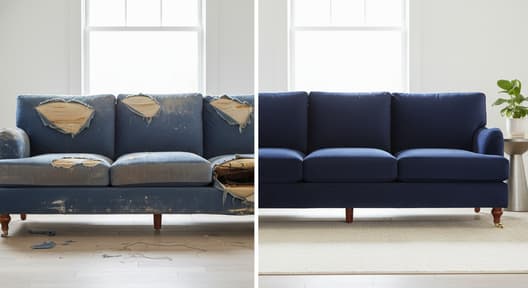
Furniture Repair vs Replace: Which Is the Smarter Choice?
Torn between repairing and replacing your old furniture? This guide compares real costs and helps you decide what makes sense for your budget and your home.